Five procurement failures that leak margin before the stock take
Authorisation, ordering context, supplier knowledge, product structure and delivery checks all affect margin before an invoice reaches finance.
HOPS Team
Product & Operations
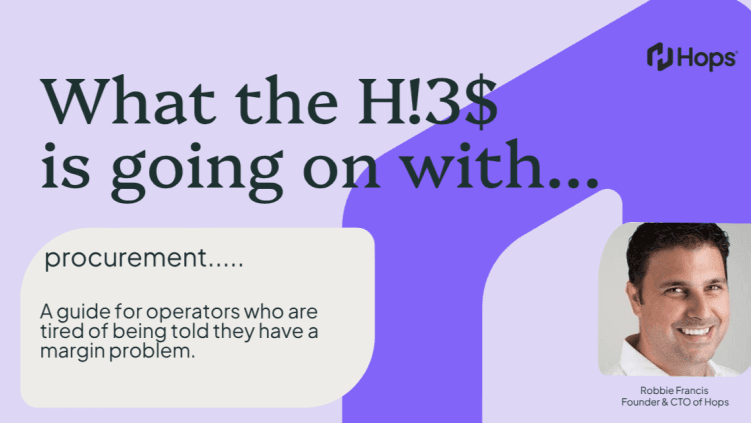
Procurement problems rarely announce themselves as one dramatic failure. They accumulate through small gaps in ordering, delivery and supplier control. By the time the stock take reveals the effect, the opportunity to challenge the original transaction may have passed.
The original Hops post introduced Robbie Francis' procurement field guide and highlighted five common failure points.
Authorisation happens too late
Approving an invoice after the goods have been ordered, delivered, prepared and served is not meaningful purchasing control. Approval needs to happen while the order can still be changed.
Ordering without context becomes guesswork
A useful ordering screen needs more than a product list. Stock on hand, usage history and comparable pack pricing help the operator understand what is needed and what it really costs. Without that context, a purchase order can formalise a guess rather than improve it.
Supplier knowledge lives with one person
When supplier history, pricing and contacts live in a chef's phone, the business loses negotiating context and continuity. A connected purchasing record gives the operation evidence it can retain and compare.
Supplier products and inventory items are treated as the same thing
The item a supplier sells is not always the item the operation uses in recipes and reporting. Keeping those concepts separate makes it possible to change supplier without rebuilding every recipe linked to the ingredient.
Delivery checking stops at quantity
A delivery asks two questions: did the correct goods arrive, and are we being charged the price that was agreed? Both need evidence. A quantity check without a price and credit route leaves margin exposed.
The LinkedIn introduction quotes an estimate that between 2% and 4% of food and drink deliveries are wrong, using £300,000 on £10 million of spend as an illustration. That figure should be treated as source commentary rather than a result guaranteed by Hops. The practical lesson does not depend on one percentage: small discrepancies become material when they repeat across every delivery and site.
Hops Inventory connects purchasing, deliveries and stock, while the integration directory shows the systems that can exchange data with Hops.
View the original LinkedIn post: Hops' procurement field guide post, published 31 July 2026
Tags