How to Calculate Food Cost (And Reduce It)
Food cost looks too high? Use this prompt to check your calculation, spot gaps in the data and decide what to investigate first.
HOPS Team
Hospitality operations
Start with one site and one stock period. Read the short version below, then copy the prompt into your company-approved AI tool. For the theory behind the prompt and a detailed explanation of food cost, keep reading.
The short version
- The benchmark: AHBS, citing The Caterer, gives 28–32% of food sales for food and 18–24% of beverage sales for drinks. The benchmark that matters most is your own best-performing comparable site.
- Why it might be high: Missing purchases, late deliveries and inaccurate stock counts can distort total consumption. Missing waste records make it harder to explain that total. Check the data before blaming portions or waste.
- How to reduce it: Don't order stuff you don't need, count what you've ordered against what arrived and check the price you agreed is the price you're paying. Then standardise portions and log waste.
Copy this prompt to calculate your food cost
Copy this prompt
Use in your company-approved AI tool
Help me check food cost for one hospitality site and one stock period. Guide me through the inputs in small groups of questions before calculating anything.
Ask for:
- Site, dates and currency
- Food-only opening stock, net food purchases, transfers in, transfers out and closing stock, all valued at cost
- Net food sales for that period, excluding VAT where applicable
- Separately recorded spoilage and actual discarded food, valued at cost
- Missing purchases, late entries, uncertain counts or gaps in waste records
Check that everything covers the same site and period, uses consistent valuation and VAT treatment, and does not duplicate transfers, supplier credits or returns. Missing information is unknown, not zero. Tell me what I need to find and calculate only what the available data supports.
Show the working for three clearly labelled figures, each as an amount and percentage of net food sales:
- Total actual food consumption: opening stock + net food purchases + transfers in − transfers out − closing stock
- Recorded wastage: separately documented spoilage and actual discards
- Waste-adjusted food cost: total actual consumption − recorded wastage
Normal preparation loss, such as trimming meat, belongs in recipe yield and food cost. Do not deduct it again as recorded wastage. A customer refusal counts as wastage only if food was actually discarded. Check that recorded wastage uses a compatible cost basis and has not already been deducted elsewhere.
Explain that the adjusted figure is a management measure, not total actual COGS or profit. It does not remove the real cost of waste or prove that everything remaining was sold. Flag impossible or suspicious inputs, including negative consumption, waste exceeding consumption and zero sales.
Finish with three prioritised checks, explaining the evidence needed for each. Separate facts from possible explanations. Do not invent causes, savings or targets, or assume the percentage is too high without a suitable comparison.
Example output with fictional figures
| Measure | Cost | % of sales |
|---|---|---|
| Total actual consumption | £21,600 | 36% |
| Recorded spoilage and discards | £1,800 | 3% |
| Waste-adjusted food cost | £19,800 | 33% |
Fictional example against £60,000 net food sales. £8,000 opening + £20,000 purchases + £1,000 transfers in − £500 transfers out − £6,900 closing = £21,600 consumed. The business still incurred £21,600; the adjusted measure does not increase gross profit.
The adjusted figure separates recorded waste; it does not make that cost disappear. Normal preparation yield loss stays within costing.
The next checks might be delivery and invoice completeness, closing-stock accuracy and the evidence behind waste records. Totals alone do not establish the cause.
How to calculate food cost: the formula
There are hundreds of articles that will give you the food cost formula. Almost none of them will tell you why the number it produces is so often wrong, or why reducing food cost usually has less to do with cheaper ingredients and more to do with process discipline.
We work with UK multi-site hospitality groups facing food cost problems. This guide covers how to do the calculation properly and how to ensure the number is trustworthy enough to act on.
Start with total actual food consumption for the period, including food that was wasted:
Opening food stock + net food purchases + transfers in − transfers out − closing food stock
Net purchases means purchases less valid supplier credits and returns, counted once. Use food-only values at cost and net food sales for the same site and period, with consistent valuation and VAT treatment. Divide total consumption by net food sales and multiply by 100 to get actual food cost percentage.
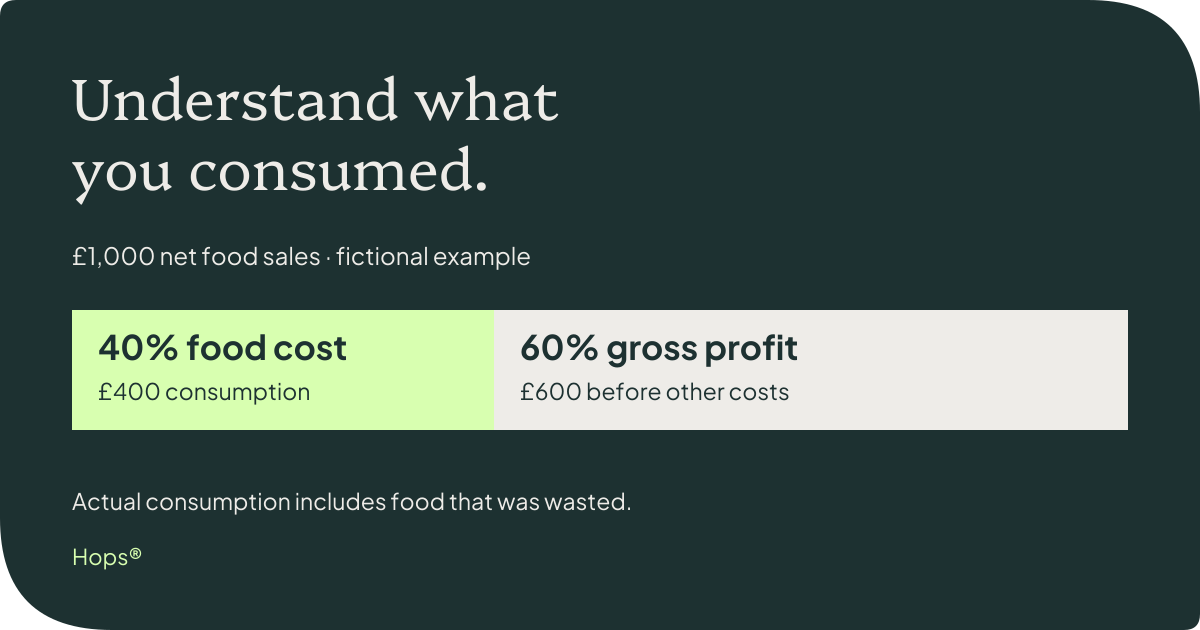
A simple example: you sell £1,000 of food and the formula says you consumed £400 of ingredients. Your actual food cost is 40% and your gross profit is £600, or 60%. If £30 of that consumption was separately recorded spoilage or discarded food, show it separately. Waste-adjusted food cost is £370, or 37%.
This is a management measure, not total actual COGS or a basis for claiming £630 of gross profit. The business still incurred £400.
There are two non-negotiable elements when calculating your food cost:
- Every input has to reflect reality. If purchases are missing, transfers between sites or departments weren't logged or stock counts are sloppy, total consumption will be wrong. Gaps in waste records affect the explanation and the adjusted measure; they do not remove waste from total consumption. Missing information is unknown, not zero.
- Use the right period. Deliveries and sales must land in the stock period they belong to. A Thursday delivery keyed in on Monday makes this week look brilliant and next week look like a crisis. Both are false.
Theoretical food cost: the other number
Your actual food cost is the cost of food consumed during the period. Your theoretical food cost is what your recipes say you should have consumed: every dish sold, multiplied by its current recipe cost, summed.
Normal preparation loss belongs in recipe yield and food cost. A 5% meat-trimming allowance leaves 0.95kg usable from 1kg purchased. That loss must be included in the usable ingredient cost, not deducted again as separately recorded waste.
The difference between actual and theoretical is your variance. For a practical investigation sequence, read our restaurant stock variance investigation checklist.
Get your actual right before you build the theoretical. Some operations don't run full recipe management at all: they keep their actual margin solid and run the business from there. Recipes, theoretical costing and variance analysis are powerful, but none of it means anything until the actual is trustworthy. Read more about actual GP before theoretical GP.
What's a good food cost percentage in the UK?
AHBS attributes a benchmark to The Caterer of 28–32% of food sales, with beverage costs at 18–24% of beverage sales. Treat this as an indicative comparison, with the secondary attribution made explicit. Published ranges vary by format.
In Hops' opinion, the industry table matters less than your own operation. If you run multiple sites on the same menu with the same suppliers, your best-performing comparable site is your benchmark. One site at a 1.5-point variance and its sister site at 5 tells you where to look. Consider differences in sales mix and trading conditions before drawing a conclusion.
Be careful with your blended GP. The bar and the kitchen are two different operations under one roof. Blend them into a single percentage and you get a number that is harder to act on. When it comes in low, the head chef blames the bar, the bar blames the kitchen and nobody can prove anything.
Split food cost and GP by department first to make accountability and investigation straightforward.
GP percentage isn't the same as margin contribution. A department running 90% GP but contributing £3,000 delivers fewer gross profit pounds than one running 65% GP and contributing £60,000. Labour and other operating costs still matter when assessing overall profitability.
For the cross-site perspective, read same dish, same price, different GP.
Why is my food cost so high?
If your calculation is above a suitable comparison, resist the instinct to march into the kitchen. Check these possible system and process causes first.
1. You're not counting all your costs
A team once celebrated 75% GP at month end. Then the accountant called: one site had been ordering through a supplier portal that wasn't connected to the system and those purchases were never logged. Their real GP was 25%.
GP looks brilliant when you're not counting all your costs. Food cost looks mysterious when some of it arrives weeks later in the wrong period. Every order that comes through the back door must exist in the system.
2. You're paying for stock you never received
Short, damaged, substituted or incorrectly priced deliveries can leak into your food cost line. Check the delivery against the purchase order at the back door before signing. Record shortages and pursue the corresponding supplier credits.
3. Supplier prices moved and nobody caught it
Fresh produce prices can move weekly. If a supplier's rate has drifted up since your menu launched and your recipes were never updated, actual cost can run above theoretical cost while the kitchen has changed nothing.
4. Portions are running heavy
Theoretical says 6kg of cheese should have gone out; the count says 10kg. Portion drift is one possible explanation, alongside spoilage, recording errors and unexplained consumption. Measured portions give you evidence to test it. Don't assume that the gap proves over-portioning.
5. Waste is happening but not being recorded
WRAP's restaurant food waste guidance recommends measuring waste, engaging staff and rethinking inventory and purchasing practices.
If your waste log is nearly empty and your food cost is high, check whether spoilage and actual discards are being recorded. An empty log is not proof of the cause. Keep discards separate from normal preparation yield loss and avoid deducting anything already accounted for elsewhere.
How to reduce food cost: the three disciplines
1. Don't order stuff you don't need
Ordering without context is guesswork. Before an order goes out, the person placing it should be able to see current stock levels, what the site typically orders per week and price per gram or millilitre across suppliers.
The control lever sits before the order. Most operations authorise payments, but by the time an invoice is approved the goods have arrived and been used. An order for 1,000 kilos of peppers instead of 10 is a problem to catch before it is sent. Pre-order authorisation limits, set per person and grown with experience, help prevent it.
2. Count what you've ordered against what arrived
Someone at the back door should check quantities against the purchase order before signing. Log shortages and flag substitutions at the moment of delivery, while the driver is still there and the discrepancy is visible on the delivery note.
3. Check the price you agreed is the price you're paying
Confirming a delivery arrived is different from confirming its price. If you agreed £10 per kilo, check that the invoice reflects it. If it doesn't, follow through: credits need to be raised, chased and reconciled.
Keep a weekly rhythm: count your 15–20 highest-value lines, close each period with every order processed and check for missing waste entries. Show the numbers to the people who control them. A completed waste review should distinguish a confirmed zero from an unknown.
Put the calculation into practice
Hops® is a hospitality operations platform built by operators for UK multi-site restaurant and hotel groups. It captures purchases at source, supports delivery checks at the back door and puts actual GP by department in front of the people who control it.
Frequently asked questions
How do you calculate food cost percentage?
Actual food cost % = (opening stock + net purchases + transfers in − transfers out − closing stock) ÷ net food sales × 100. For a single dish: yield-adjusted ingredient cost ÷ net menu price × 100.
What is a good food cost percentage for a UK restaurant?
AHBS, attributing its guidance to The Caterer, gives 28–32% of food sales and beverage costs of 18–24% of beverage sales. Formats vary. In a multi-site group, compare sites with similar menus, suppliers and trading conditions.
Why is my food cost high even though nothing changed in the kitchen?
Possible explanations include purchases entering the system late or not at all, supplier price rises, deliveries you paid for but did not fully receive or food being discarded. Check the data first. Unrecorded waste remains within total consumption; a missing log makes it harder to explain.
Is food cost the same as cost of goods sold (COGS)?
Total actual food cost is your food-only COGS for this calculation; a full COGS figure also includes beverage and other stock categories. Waste-adjusted food cost is a separate management measure and must not be labelled total actual COGS. Keep food and beverage separate in reporting.
How often should I calculate food cost?
Every stock period. Count your highest-value lines weekly and carry out full counts monthly at minimum. Shorter periods make problems easier to trace.
Tags